Four Hours of Winter Sun: The Honest Maths of Solar CCTV
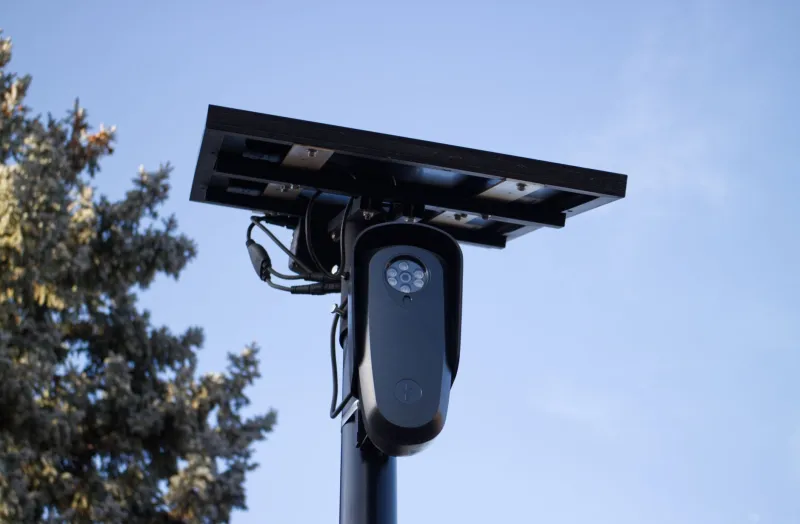
There's a particular kind of disappointment that arrives around the second week of December. You bought a solar camera in the spring, it sat on the shed roof all summer doing exactly what it said on the box, and then one evening in the dark you open the app and get a grey screen and a battery icon with a sad little sliver in it.
That isn't usually a faulty unit. It's arithmetic. Solar CCTV works, but it works seasonally, and most of the marketing material you'll read was written with a June afternoon in mind.
What 'wire-free' is really promising you
Strip away the branding and every solar camera is a small energy business. On one side you have income: a panel of a few watts converting daylight into charge. On the other side you have outgoings: the camera's standby draw, the radio waking up, the infrared LEDs, the processor compressing a clip and pushing it over 4G.
If income exceeds outgoings, the battery fills and everything is lovely. If it doesn't, the battery drains and eventually the camera shuts itself down to protect the cells. There's no clever firmware that gets around this. It's a bucket with a hole in it and a tap above it, and in winter the tap slows to a drip.
The winter yield problem, in plain numbers
Panel ratings are quoted at standard test conditions: bright lab-standard light and a panel temperature of 25°C. A 5W panel is a 5W panel in a lab. On your garage roof in Leicestershire in January, it is nothing of the sort.
A rough way to think about it is peak sun hours. Much of the UK gets something like four to five of those on a decent June day, and perhaps half an hour to an hour and a half in December depending on how far north you are and how grim the cloud has been. So that 5W panel might deliver 20 to 25 watt-hours a day in midsummer and somewhere between three and seven watt-hours a day in midwinter. Add a few days of heavy overcast and it's worse than that.
Now the other side of the ledger. A 4G camera that sits in a low-power state waiting for its PIR sensor still draws something, and plenty of budget models average a fraction of a watt continuously. Over 24 hours, half a watt is 12 watt-hours. Even a well-behaved unit at 0.2W is chewing through nearly 5 watt-hours before it has recorded a single clip.
You can see the shape of the problem. Winter income of three to seven watt-hours against a demand of five to twelve. The battery makes up the difference for a while, and then it doesn't.
Cold takes its cut too
Lithium cells don't love the cold. Capacity drops noticeably as the temperature falls, so a 10,000mAh battery in a shed at 2°C is not delivering the same number of usable milliamp-hours it managed in August.
More importantly, many lithium iron phosphate packs refuse to charge below freezing at all. The battery management system blocks it deliberately, because charging a cold LiFePO4 cell damages it. That's a sensible safety feature and a terrible experience when your camera's only charging window is a frosty 9am to 2pm.
So you get a double hit: less sun coming in, less capacity in the tank, and a charging window that slams shut on the coldest mornings.
Cloud is not the only thief
Before you blame the weather, check the boring things.
- Panel angle and direction. Flat on a shed roof is convenient and wrong. You want it tilted and facing somewhere between south-east and south-west.
- Shading. A hedge, a fence post, a chimney or the shed's own ridge can wipe out a surprising amount of a small panel's day.
- Grime and snow. A dirty panel in December is a dead panel. So is one under two inches of snow for a week.
- Cable runs. Long, thin DC leads between panel and camera lose voltage. Short and thick beats long and hopeful.
- Signal quality. A weak 4G signal makes the modem work harder and retry more, which quietly raises the power draw.
Where these cameras genuinely earn their keep
None of this means solar cameras are a con. It means they need to be bought for the worst month, not the best one.
They work well where recording is event-triggered rather than continuous, clips are short, resolution is sensible rather than maximal, and the panel is generously oversized. A camera that sleeps deeply and wakes in under a second is a different animal from one that streams live video every time a fox walks past.
They also work better as a summer-biased system with realistic expectations. If your allotment shed is covered from March to October and goes quiet in the depths of winter, that may be a perfectly reasonable trade for a site where running mains power was never going to happen.
The pre-purchase checklist
Before you click buy on anything described as wire-free, look for these in the spec sheet or the listing's small print.
- Battery capacity in watt-hours, not just milliamp-hours. Watt-hours tell you the real size of the tank.
- Stated standby or average consumption. If it isn't published, assume the worst.
- Panel wattage and, ideally, a winter figure. Any seller who claims all-year performance in the UK should be able to explain how.
- Charging temperature range. Look for the low-temperature cut-off. It's usually buried in the manual rather than the marketing.
- Days of autonomy. How long will it run with zero sun? Two days is a weekend. Seven days is a winter.
- The app's diagnostics. You want battery percentage and solar input visible, so you can see trouble coming in November rather than discovering it in January.
- Buy in autumn if you want the truth. A camera bought in June will flatter itself for months before it has to face reality.
The alternatives worth pricing up
If the sums don't work for your site, there are options other than hoping.
A low-voltage cable from the house to the outbuilding is often cheaper than people assume, and it removes the whole energy argument. Power over Ethernet does the same job and gives you a rock-solid network connection into the bargain. If digging is impossible, a larger separate panel, a bigger battery and a proper charge controller cost more up front but give you headroom you can actually measure.
And sometimes the honest answer is a decent battery-powered PIR light and a camera that only claims to cover the brighter half of the year. That's not a failure. It's just knowing what you bought.
Solar CCTV isn't a magic trick. It's a small off-grid power system with a camera attached, and in a British winter the power system is the part that decides whether you get footage. Buy for December and the rest of the year looks after itself.