Your Camera Is Listening: The Microphone Setting Nobody Ever Checks
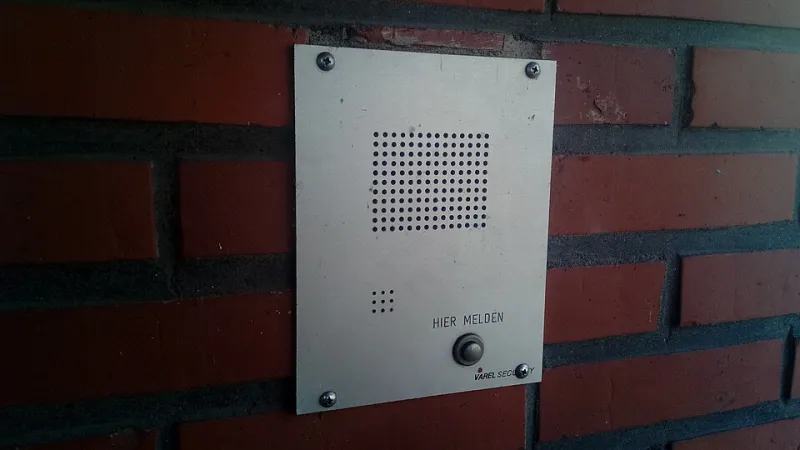
Photo: Donald Trung Quoc Don (Chữ Hán: 徵國單) - Wikimedia Commons - © CC BY-SA 4.0 International.(Want to use this image?)Original publication 📤: --Donald Trung 『徵國單』 (No Fake News 💬) (WikiProject Numismatics 💴) (Articles 📚) 21:46, 9 October 2020 (UTC), CC
Here's a small experiment. Go into the settings of the CCTV system you look after — home, shop, whatever — and find the audio tab. If it's anything like most installs I've poked at, the microphone will be enabled, the audio stream will be recording, and nobody will have thought about it once since the day it went in.
That's the bit that niggles at me. Not that people choose to record sound. That most people never chose at all.
The tick box nobody remembers ticking
Cameras ship with sound on because it's a feature on the box, so the firmware default is enable. Installers get asked about resolution, night vision and how good the app is; almost nobody asks "and is it recording the sound?". Fair enough — it's not the exciting part of a quote.
And so a system bought to watch a back door is also, incidentally, taping whatever gets said within a few metres of it. Usually nothing interesting. Occasionally a phone call, an argument, a card number read aloud at the till.
Pictures and sound are two different questions
Filming someone is one thing. Recording their conversation is another. A voice carries far more than a face: health details, relationship troubles, money, a frank opinion about the boss, a PIN read out in the wrong place. From a data protection angle, audio is generally treated as the more intrusive form of capture, and a system put in to protect property rarely has a solid reason to collect it.
I'm not a lawyer and this isn't legal advice. But the broad shape in the UK: images and audio both count as personal data when they identify people, and both need a purpose behind them. Audio is the harder one to justify, because the usual reasons for CCTV — deterrence, incident evidence, safety — are overwhelmingly served by pictures alone.
People also lean heavily on the household exemption, and it's worth being cautious there. The personal and household exemption in the Data Protection Act 2018 covers ordinary domestic activity, but it isn't a force field, and it certainly doesn't stretch to a business premises.
The shared driveway is the awkward one
Flat, terrace, converted barn, anything with a communal parking area — if your doorbell camera or back-of-house camera looks over ground you share, the mic is picking up your neighbours' conversations. Not on purpose. Simply because sound doesn't respect the boundary the lens respects.
This is the case that generates complaints, and it's easy to see why. The neighbour unhappy about the camera's view has an argument you can at least negotiate — angle it down, mask the edge, move it along the wall. The neighbour unhappy about being recorded chatting to their partner in their own car has a cleaner point, because there's no version of "protect my front door" that requires a microphone.
If your camera watches anything shared, my strongest recommendation in this piece is simple: switch the sound off. If some reason stops you, at least revisit it honestly.
The shop counter is the other one
In retail, the over-counter camera is often the one with audio, because whoever specified it thought sound would help with disputes. Occasionally it does — a refund argument, a "you told me it was half price" moment.
But the same mic catches staff discussing a hospital appointment, a customer reciting a phone number for a delivery, and the full soundtrack of a busy Saturday. Card machine beeps, yes. Also everybody's business.
If you run a shop and you're keeping audio, you should be able to answer three questions: what's the purpose, is it confined to the counter, and who can play it back? A commercial reason is entirely possible. "We left the default on" isn't one.
What audio actually earns you
In my experience, the evidential value is smaller than people hope. Camera-mounted mics are tinny, distant and full of fridges humming, traffic and a radio in the back room. A claims handler will take a clear picture over a muffled argument every time, and a partial recording can raise more questions than it settles.
The genuinely useful cases are narrow: a till dispute where the exact words matter, a doorbell intercom where sound is live rather than recorded, or a lone-worker setup where audio is part of a documented safety plan. Notice that two of those aren't recordings and the third is a deliberate choice with a file behind it.
How to switch it off
It varies by brand, but the path is nearly always in the camera's own settings rather than the recorder's. Look for a tab marked Audio, Sound, or Media → Audio, and disable the audio input — or untick record audio on the stream. On many recorders you then need to check the recording schedule to make sure audio isn't still being captured alongside the video. Sometimes the mic is off in one menu and the stream still carries a silent track; that's fine, nothing is being written.
Some battery doorbells and consumer cameras bury it two menus deep, and a few tie audio to a subscription feature. Test it afterwards: stand near the camera, say something distinctive, then play it back through the app. If you can hear yourself, it's still on.
If you've decided to keep audio, do four things. Write down why. Put up signage that mentions sound as well as pictures — a notice saying "CCTV recording images and audio" is more honest than one that doesn't. Restrict who can listen back. And keep the audio retention shorter than the video where the system allows, because sound has a short useful life.
My rule of thumb
Pictures answer "what happened?". Sound rarely adds much and often adds risk. So the default in my head is deliberately dull:
- Home system, no shared boundaries: harmless but pointless. Off.
- Home system watching anything shared: definitely off.
- Shop or office: justify per camera, or don't. If the till dispute is real, one counter camera with a written reason beats six cameras quietly listening to everything.
- Anything involving staff or the public: assume someone will eventually ask, and make sure the answer isn't "we forgot".
The frustrating part is how small the fix is. A checkbox and a two-minute playback test. The expensive part is finding out three years later that your property-protection system has doubled as an unconsented listening device over next door's drive — and that the first time anyone opened that menu was the morning the complaint landed.
Go and check yours. It'll take five minutes.
Opinion and general information only — not legal advice. For staff monitoring, shared premises or an active dispute, get proper guidance.